 |
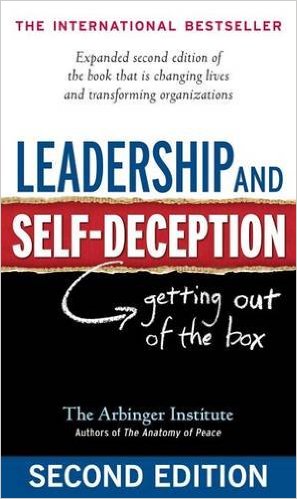
Leadership and Self-Deception uses an entertaining story about an executive facing challenges at work and at home to expose the precise psychological processes that conceal our true motivations and intentions from us and trap us in a “box” of endless self-justification. Most importantly, the book shows us the way out. The book’s central insight—that the key to leadership lays not in what we do, but in who we are—has proved to have powerful resonances not only for organizational leadership, but in readers’ personal lives as well.
This new edition has been revised throughout to make the story more readable and compelling. And drawing on the extensive correspondence they’re received over the years the authors have added a section that outlines the many ways that readers have been using this book. -Amazon.com
|
| |
|
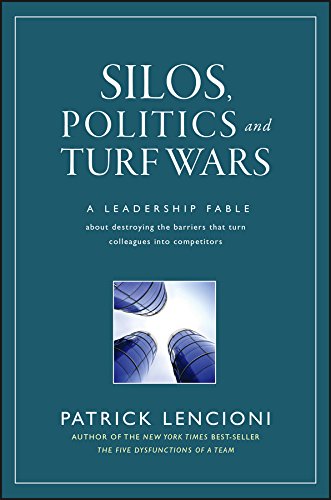 |
Silos, Politics and Turf Wars - Marketing won't speak to engineering. Sales thinks production hogs the budget. Front desk believes back room's lazy. These sorts of turf wars, which turn outwardly unified companies into groupings of uncommunicative "silos," are the stuff of management lore. According to bestselling author Lencioni (The Five Dysfunctions of a Team), "they waste resources, kill productivity and jeopardize the achievement of goals"—they also drive workers into tizzies of frustration. Like his previous books, Lencioni's latest addresses the management problem through a fictional story; this one revolves around a self-employed consultant named Jude, who has to dismantle silos at an upscale hotel, a technology company and a hospital. Split into two sections, Lencioni's book first shows Jude discovering a solution to silos, then summarizes Jude's lessons into a strategy that readers can apply to any business. Lencioni's proposal is so full of common sense—namely, end turf wars by getting departments to rally around a common goal—that managers will be eager to apply it themselves. Just as refreshing is Lencioni's use of character and plot, which is far above average for the business genre. As sympathetic as Jude is, he makes Lencioni's management lessons memorable. (Mar.)
Copyright © Reed Business Information, a division of Reed Elsevier Inc. All rights reserved. - Publishers Weekly
|
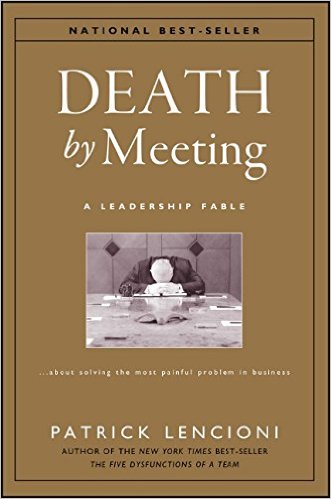 |
Death by Meeting - The business meeting—a necessary evil or a vital and invigorating component of running an organization? According to management consultant Lencioni (The Five Temptations of a CEO), meetings should fit the latter description, but more often than not, he says, they don't. In this lackluster audio fable, Lencioni offers practical advice on how to revitalize your business by energizing your business meetings, but his pallid, passive prose would challenge the most skilled narrator, and Arthur is no exception. The voice Arthur lends Will, the young hero of this tale, resembles that of Sesame Street's Ernie on downers, and the various inflections he gives business owner Casey McDaniel and his management team don't make up for the characters' lack of character. Nevertheless, Lencioni's message comes across loud and clear—meetings should be interactive, not passive, and they should be structured (i.e., issues of immediate importance should be discussed in "weekly tactical" meetings, and issues that will fundamentally affect the business should be addressed in "monthly strategic" meetings). Although managers will find this advice worthwhile, they would gather just as much if they skipped the sluggish fable and listened to the last few tracks.
Copyright © Reed Business Information, a division of Reed Elsevier Inc. All rights reserved. - Publishers Weekly
|
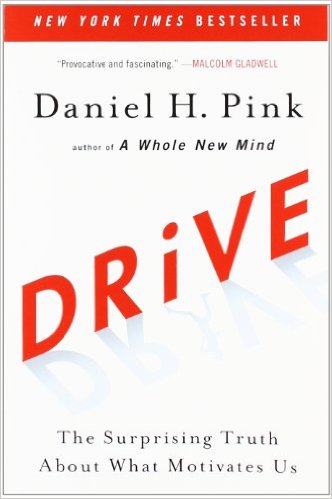 |
Drive - Most people believe that the best way to motivate is with rewards like money—the carrot-and-stick approach. That's a mistake, says Daniel H. Pink (author of To Sell Is Human: The Surprising Truth About Motivating Others). In this provocative and persuasive new book, he asserts that the secret to high performance and satisfaction-at work, at school, and at home—is the deeply human need to direct our own lives, to learn and create new things, and to do better by ourselves and our world.
Drawing on four decades of scientific research on human motivation, Pink exposes the mismatch between what science knows and what business does—and how that affects every aspect of life. He examines the three elements of true motivation—autonomy, mastery, and purpose-and offers smart and surprising techniques for putting these into action in a unique book that will change how we think and transform how we live. - Amazon.com
|
 |
Leadership from the Inside Out - Kevin Cashman’s breakthrough business bestseller that clearly connected personal growth to leadership effectiveness, is now completely revised and updated with:
• an explosion of new validating independent research
• impressive new case studies
• new tools and practices
• an even more powerful virtual coaching experience
Still framed in seven simple yet profound “mastery areas,” this book serves as an integrated coaching experience that helps leaders understand how to harness their authentic, value-creating influence and elevate their impact as individuals, in teams, and in organizations. Cashman demonstrates that his trademark “whole-person” approach—we lead by virtue of who we are—is essential to sustained success in today’s talent-starved marketplace and provides a measurable return on investment. For everyone from CEOs to emerging leaders, this long-awaited second edition advances the art and science of leadership and is even more relevant today than when it was first published. - Amazon.com
|
 |
An Everyone Culture - In most organizations nearly everyone is doing a second job no one is paying them for—namely, covering their weaknesses, trying to look their best, and managing other people’s impressions of them. There may be no greater waste of a company’s resources. The ultimate cost: neither the organization nor its people are able to realize their full potential.
What if a company did everything in its power to create a culture in which everyone—not just select “high potentials”—could overcome their own internal barriers to change and use errors and vulnerabilities as prime opportunities for personal and company growth?
Robert Kegan and Lisa Lahey (and their collaborators) have found and studied such companies—Deliberately Developmental Organizations. A DDO is organized around the simple but radical conviction that organizations will best prosper when they are more deeply aligned with people’s strongest motive, which is to grow. This means going beyond consigning “people development” to high-potential programs, executive coaching, or once-a-year off-sites. It means fashioning an organizational culture in which support of people’s development is woven into the daily fabric of working life and the company’s regular operations, daily routines, and conversations.
An Everyone Culture dives deep into the worlds of three leading companies that embody this breakthrough approach. It reveals the design principles, concrete practices, and underlying science at the heart of DDOs—from their disciplined approach to giving feedback, to how they use meetings, to the distinctive way that managers and leaders define their roles. The authors then show readers how to build this developmental culture in their own organizations.
This book demonstrates a whole new way of being at work. It suggests that the culture you create is your strategy—and that the key to success is developing everyone. - Amazon.com
|
| |
|
 |
Five Dysfunctions of a Team - In The Five Dysfunctions of a Team Patrick Lencioni once again offers a leadership fable that is as enthralling and instructive as his first two best-selling books, The Five Temptations of a CEO and The Four Obsessions of an Extraordinary Executive. This time, he turns his keen intellect and storytelling power to the fascinating, complex world of teams.
Kathryn Petersen, Decision Tech's CEO, faces the ultimate leadership crisis: Uniting a team in such disarray that it threatens to bring down the entire company. Will she succeed? Will she be fired? Will the company fail? Lencioni's utterly gripping tale serves as a timeless reminder that leadership requires as much courage as it does insight.
Throughout the story, Lencioni reveals the five dysfunctions which go to the very heart of why teams even the best ones-often struggle. He outlines a powerful model and actionable steps that can be used to overcome these common hurdles and build a cohesive, effective team. Just as with his other books, Lencioni has written a compelling fable with a powerful yet deceptively simple message for all those who strive to be exceptional team leaders. - Amazon.com
|
| |
|
 |
everything is workable - Conflict is going to be part of your life—as long as you have relationships, hold down a job, or have dry cleaning to be picked up. Bracing yourself against it won’t make it go away, but if you approach it consciously, you can navigate it in a way that not only honors everyone involved but makes it a source of deep insight as well. Seasoned mediator Diane Hamilton provides the skill set you need to engage conflict with wisdom and compassion, and even—sometimes—to be grateful for it. She teaches how to:
• Cultivate the mirror-like quality of attention as your base
• Identify the three personal conflict styles and determine which one you fall into
• Recognize the three fundamental perspectives in any conflict situation and learn to inhabit each of them
• Turn conflicts in families, at work, and in every kind of interpersonal relationship into win-win situations - Amazon.com
|
| |
|
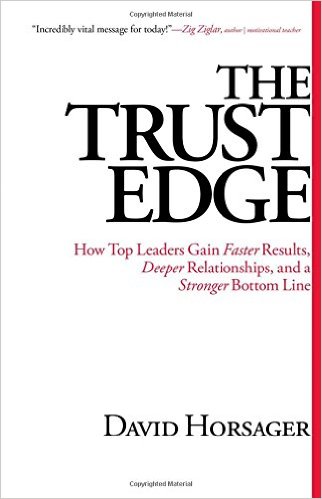 |
In The Trust Edge, David Horsager reveals the foundation of genuine success—trust. Based on research but made practical for today’s leader, The Trust Edge shows that trust is quantifiable and brings dramatic results to businesses and leaders. In this book, Horsager teaches readers how to build the 8 Pillars of Trust:
1. Clarity: People trust the clear and mistrust the ambiguous.
2. Compassion: People put faith in those who care beyond themselves.
3. Character: People notice those who do what is right over what is easy.
4. Competency: People have confidence in those who stay fresh, relevant, and capable.
5. Commitment: People believe in those who stand through adversity.
6. Connection: People want to follow, buy from, and be around friends.
7. Contribution: People immediately respond to results.
8. Consistency: People love to see the little things done consistently.
When leaders learn how to implement these pillars, they enjoy better relationships, reputations, retention, revenue, and results. Fascinating and timely, The Trust Edge unveils how trust has the ability to accelerate or destroy any business, organization, or relationship. The lower the trust, the more time everything takes, the more everything costs, and the lower the loyalty of everyone involved. Conversely, an environment of trust leads to greater innovation, morale, and productivity. The trusted leader is followed. From the trusted salesperson, people will buy. For the trusted brand, people will pay more, come back, and tell others. Trust, not money, is the currency of business and life! - Amazon.com
|
| |
|
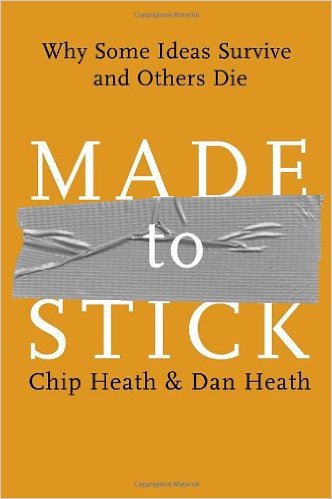 |
Made to Stick - Mark Twain once observed, “A lie can get halfway around the world before the truth can even get its boots on.” His observation rings true: Urban legends, conspiracy theories, and bogus public-health scares circulate effortlessly. Meanwhile, people with important ideas–business people, teachers, politicians, journalists, and others–struggle to make their ideas “stick.”
Why do some ideas thrive while others die? And how do we improve the chances of worthy ideas? In Made to Stick, accomplished educators and idea collectors Chip and Dan Heath tackle head-on these vexing questions. Inside, the brothers Heath reveal the anatomy of ideas that stick and explain ways to make ideas stickier, such as applying the “human scale principle,” using the “Velcro Theory of Memory,” and creating “curiosity gaps.”
In this indispensable guide, we discover that sticky messages of all kinds–from the infamous “kidney theft ring” hoax to a coach’s lessons on sportsmanship to a vision for a new product at Sony–draw their power from the same six traits.
Made to Stick is a book that will transform the way you communicate ideas. It’s a fast-paced tour of success stories (and failures)–the Nobel Prize-winning scientist who drank a glass of bacteria to prove a point about stomach ulcers; the charities who make use of “the Mother Teresa Effect”; the elementary-school teacher whose simulation actually prevented racial prejudice. Provocative, eye-opening, and often surprisingly funny, Made to Stick shows us the vital principles of winning ideas–and tells us how we can apply these rules to making our own messages stick. - Amazon.com
|
 |
Amazon Best of the Month, November
2008: Now that he's gotten
us talking about the viral life of ideas and the power of gut reactions,
Malcolm Gladwell poses a more provocative question in Outliers: why do
some people succeed, living remarkably productive and impactful lives,
while so many more never reach their potential? Challenging our cherished
belief of the "self-made man," he makes the democratic assertion
that superstars don't arise out of nowhere, propelled by genius and talent: "they
are invariably the beneficiaries of hidden advantages and extraordinary
opportunities and cultural legacies that allow them to learn and work hard
and make sense of the world in ways others cannot." Examining the
lives of outliers from Mozart to Bill Gates, he builds a convincing case
for how successful people rise on a tide of advantages, "some deserved,
some not, some earned, some just plain lucky."
|
 |
An organization's fate hinges
on its CEO—right? Not according to the authors of Senior Leadership
Teams. They argue that in today's world of neck-snapping change, demands
on leaders in top roles are rapidly outdistancing the capabilities of
any one person--no matter how talented. Result? Chief executives are
turning to their enterprise's senior leaders for help. Yet many CEOs
stumble when creating a leadership team. One major challenge is that
senior executives often focus more on their individual roles than on
the top team's shared work. Without the CEO's careful attention to setting
the team up correctly, these high-powered managers often have difficulty
pulling together to move their organization forward. Sometimes they don't
even agree about what constitutes the right path forward. Timely
and practical, this book enables you to create and sustain a leadership
team whose members learn from one another while collaborating to pursue
your company's objectives. - Amazon.com
product information
|
 |
From the Inside Flap
No-Nonsense, Battle-Tested Program for Developing
Exceptional Leadership Skills—Both In Your Organization and Yourself.
The ability to lead, far more than just a natural gift, is a concrete
and learnable skill—one that can be acquired by studying and applying
specific proficiencies and attitudes. The Extraordinary Leader draws
on responses from 200,000 questionnaires to define the skills that comprise
effective leadership, and then provides a systematic and innovative program
for attaining, developing, and implementing those skills.
|
 |
From Publishers Weekly
Readers who accept poet and Fortune 500 consultant
Whyte's invitation to enter into "an imaginative conversation about
life and work" are
likely to be challenged as well as delighted by the beauty of his writing
and the expansiveness of his views. Gracefully using the metaphor of
a sea voyage to depict the journey through the world of work, Whyte
views work not only as a means of support, but as a means for interacting
with the world and developing self-expression and identity. Interwoven
with and undergirding Whyte's philosophy are passages of memoir, detailing
his unique experiences as a naturalist in the Gal pagos Islands, for
example, together with poetic references from Whitman, Spender, Dickinson,
Rilke, Wordsworth and Whyte's own works. Even Whyte's friends are wise,
as evidenced by a monk who tells him that the antidote to exhaustion
is not rest but "wholeheartedness." Thoughtful
readers will wholeheartedly savor this book. Agent, Ned Leavitt. (Apr.
2) Copyright
2001 Cahners Business Information, Inc.
|
 |
Ken Blanchard,
coauthor of The One Minute Manager® and The On-Time, On-Target ManagerThis
book is brimming with great ideas for making our working lives better.
And when work is working for us, that's when we can serve ourselves
and others best.
|
 |
From Publishers Weekly
Anxiety is an unfortunate fact of life, but can be
a positive force in business success, says psychologist Rosen, contending
that today's rapid rate of change is particularly anxiety provoking for
businesses and those who work to build them. Rosen believes that business
leaders can manage their own anxiety to yield positive company results.
Though our minds try to protect us from anxiety by using ego defense mechanisms
that can be productive or destructive, either too much or too little anxiety
can be a hindrance to performance. But the right amount of anxiety can
motivate and encourage. With checklists, questionnaires and self-evaluation
forms, Rosen offers tools and guidelines to help readers assess and understand
their personal reactions to the emotion. Concrete, real-life examples
and explanations of anxiety's various forms, personal effects and potentially
positive aspects teach managers how to work with the emotion and elicit
its healthy side from employees. Rosen's insights are thought provoking
and helpful. (Mar. 13) Copyright © Reed
Business Information, a division of Reed Elsevier Inc. All rights reserved.
|
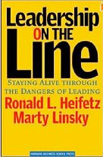 |
Amazon.com Review
Climbing Mount Everest: dangerous. Hitchhiking in
Colombia: very dangerous. Leading through change: perilous. Perilous but
possible, say Heifetz and Linsky in their encouragingly practical guide
to putting yourself on the line and negotiating the hazards of leadership.
As the authors acknowledge, many leadership books are "all about inspiration, but
downplay the perspiration." This one doesn't. Leadership is always
a risky business, but those risks can be understood and reduced. Heifetz
and Linsky examine four forms of resistance--marginalization, diversion,
attack, and seduction--before presenting a number of practical resistance-response
skills to nurture and employ. Some are fairly obvious (like developing
and maintaining perspective, and holding steady in the midst of change),
and others more complex (like thinking politically when dealing with
friends, foes, and fence sitters), but shimmering nuggets of insight
and practical wisdom can be found in each. The dangers of leadership
also spring from within, however, and the book's final section addresses
ways to recognize and manage competing "hungers" and
learn to distinguish one's roles from one's self. --S. Ketchum
|
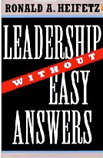 |
From Library Journal
Heifetz (Kennedy Sch. of Government, Harvard Univ.)
presents a new theory of leadership for both public and private leaders
in tackling complex contemporary problems. Central to his theory is the
distinction between routine technical problems, which can be solved through
expertise, and adaptive problems, such as crime, poverty, and educational
reform, which require innovative approaches, including consideration of
values. Four major strategies of leadership are identified: to approach
problems as adaptive challenges by diagnosing the situation in light of
the values involved and avoiding authoritative solutions, to regulate the
level of stress caused by confronting issues, to focus on relevant issues,
and to shift responsibility for problems from the leader to all the primary
stakeholders. The theory is applied to an analysis of historical accounts
of local, national, and international events. An innovative and thoroughgoing
work; highly recommmended for graduate and undergraduate collections. Jane
M. Kathman, Coll. of St. Benedict Lib., St. Joseph, Minn. Copyright 1994
Reed Business Information, Inc.
|
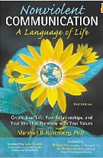 |
"Nonviolent Communication is
a masterwork. Nationally, we talk peace. This book goes far beyond mere
talk. . . . It shows us how to TEACH peace." -James E. Shaw, Ph.D.,
author, Jack and Jill, Why They Kill"Nonviolent Communication is
a powerful tool for peace and partnership. It shows us how to listen
empathically and also communicate our authentic feelings and needs. Marshall
Rosenberg has a genius for developing and teaching practical skills urgently
needed for a less violent, more caring world." -Riane
Eisler, author, The Chalice and the Blade, Tomorrow's Children, and The
Power of Partnership |
| |
|